Wetter than Normal on the West, Drier than Normal in the East. But Why? - Hallo frends over position, thank you for visiting this blog Wetter than Normal on the West, Drier than Normal in the East. But Why?, We have prepared this article well for you to read and take information in it. hopefully the contents of the post what we wrote you can enjoy, send your video to metart30@gmail.com and we are very happy to publish it like the video below
Judul : Wetter than Normal on the West, Drier than Normal in the East. But Why?
link : Wetter than Normal on the West, Drier than Normal in the East. But Why?

.png)
So why did we get this precipitation pattern, which is clearly tied closely with the terrain?
.png) Northwesterly winds cause air to be pushed up the western side of the Cascades...increasingly precipitation there (enhanced upward motion results in more precipitation).
Northwesterly winds cause air to be pushed up the western side of the Cascades...increasingly precipitation there (enhanced upward motion results in more precipitation).
meet me now directly in my private room Wetter than Normal on the West, Drier than Normal in the East. But Why? Cream pie is the term for the process by which a man ejaculates into a vagina without using a condom and then allows the semen to ooze out. Cream pie is also referred to as an internal cum shot. Specifically refers to the visible dripping of semen from the vagina. Typically a shot of a vaginal cream pie is referred to as the "money shot". Enjoy this site. WHAT IS A CREAMPIE? Cream pie is the term for the process by which a man ejaculates into a vagina without using a condom and then allows the semen to ooze out. Cream pie is also referred to as an internal cum shot. Specifically refers to the visible dripping of semen from the vagina. Typically a shot of a vaginal cream pie is referred to as the "money shot https://overanbola.blogspot.com/2022/05/wetter-than-normal-on-west-drier-than.html
Judul : Wetter than Normal on the West, Drier than Normal in the East. But Why?
link : Wetter than Normal on the West, Drier than Normal in the East. But Why?
Wetter than Normal on the West, Drier than Normal in the East. But Why?
During the past year, precipitation contrasts across the Cascades were greater than normal.
The normally wet western side was wetter than normal.
The normally dry area east of the Cascade crest was drier than normal.
But WHY?
By the time you finish this blog, you will know!
Let's start by showing you difference from normal of the precipitation over the state from October 1 through the end of March (see below).
Hugely wetter than normal over the western slopes of the Cascades and over the northwest side of the Olympics (purple colors). But eastern Washington was 0 to 4 inches below normal (yellow colors).
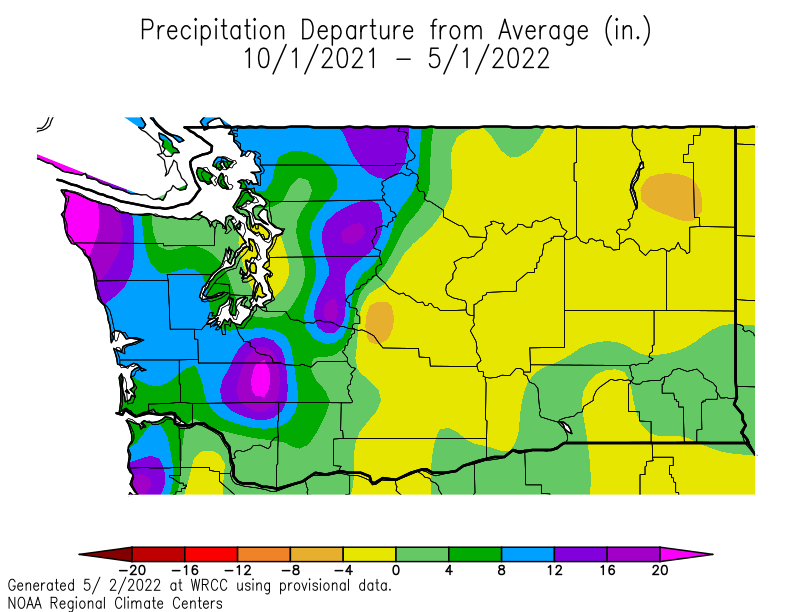
Since eastern Washington is such a dry place, if you really want to be impressed, take a look at the percentage of precipitation for the same period. Some places on the western side were over 130% of normal, but in eastern Washington, along the eastern slopes of the Cascades and downstream of the Okanagan Highlands, some locations were 50-70% of normal.
The deficit in inches was small, but if one is talking about an area that is essentially desert, a small drop in inches can be a large percentage.
.png)
So why did we get this precipitation pattern, which is clearly tied closely with the terrain?
The answer is La Nina and the large-scale atmospheric pattern it created. And remember, La Ninas are associated with colder than normal sea surface temperatures in the central and eastern tropical Pacific.
Take a look at the pressures or heights at 850 hPa (about 5000 ft)--see below.
This plot is showing the difference from normal. Over the Pacific, pressure were higher than normal at this level. Over western Canada, the pressures were lower than normal.
The result of these two pressure features was an area of large pressure change over the northwest...and large pressure changes result in winds. And since winds at this level (around 5000 ft) tend to parallel the pressure lines, this situation produced an enhanced northwesterly wind (from the northwest, see the arrow)
.png)
But northwesterly winds also produce more downward flow on the eastern side of the Cascades, resulting in more downward flow that decreases precipitation.


So what does this have to do with La Nina? Because La Nina situations tend to produce exactly this pressure pattern.
Want proof? Here is the plot of differences from normal pressure at around 18,000 ft for La Nina years from a NOAA website. Mama Mia! It looks just like the figure above.
So colder than normal waters over the central/eastern tropical Pacific resulted in a strong La Nina this fall and winter, that produced an offshore high and an inland low that led to stronger than normal northwesterly winds, that produced enhanced upslope flow on the western side of the Cascades and downslope flow to the east, which in turn modulated precipitation.
Kind of reminds you of something:
That's the article Wetter than Normal on the West, Drier than Normal in the East. But Why?
are you satisfied Wetter than Normal on the West, Drier than Normal in the East. But Why? so you can see lots of photos and videos
meet me now directly in my private room Wetter than Normal on the West, Drier than Normal in the East. But Why? Cream pie is the term for the process by which a man ejaculates into a vagina without using a condom and then allows the semen to ooze out. Cream pie is also referred to as an internal cum shot. Specifically refers to the visible dripping of semen from the vagina. Typically a shot of a vaginal cream pie is referred to as the "money shot". Enjoy this site. WHAT IS A CREAMPIE? Cream pie is the term for the process by which a man ejaculates into a vagina without using a condom and then allows the semen to ooze out. Cream pie is also referred to as an internal cum shot. Specifically refers to the visible dripping of semen from the vagina. Typically a shot of a vaginal cream pie is referred to as the "money shot https://overanbola.blogspot.com/2022/05/wetter-than-normal-on-west-drier-than.html